
Friends in All Places
Jack Carnefix's 40-plus years promoting baseball, hockey, bull riding, and wrestling.

I had never heard of Jack Carnefix until he reached out with kind words about a prior Substack article I had written. I did a Google search, and along with discovering that Curt Cignetti wins, I discovered that Jack is the Operations Manager for the National Wrestling Hall of Fame and had previously worked in sports information and PR for the Professional Bull Riders Association, minor league baseball, minor league hockey, and Oklahoma State University.
Jack has a Substack himself titled You Know Jack, which I enjoyed reading, so I reached out to have a conversation with him. We covered the waterfront from his time at Oklahoma State with Robin Ventura, Pete Incaviglia, Barry Sanders, and Garth Brooks, to promoting bull riding to young mothers, to a minor league baseball Letterman Night promotion gone horribly wrong.
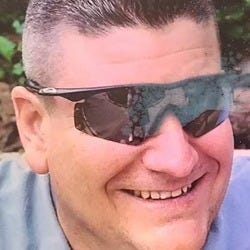
Below is a transcript of our conversation edited for brevity and clarity.
AJS - Jack, great to meet you, really like your Substack, and thanks for the kind words on my articles. How did you get your start in sports?
JC: My dad was a naval aviator, so we moved around a lot. I was born in Kingsville, Texas, and then we moved to North Abington, MA, which I only remember because my mom used to threaten to leave me at the North Abington dump when I misbehaved. We then moved to Northern California and then to Southern California.
When I was nine, my dad came home and said we had a change in orders. I asked where, and he said Stillwater, Oklahoma.
So I get an encyclopedia, do a lot of research, and there is no reason for the United States Navy to be in Stillwater, Oklahoma. So I went to our neighbors and said I am moving in with you because I think they will be back soon, so let’s keep the options open.
AJS: I am guessing your parents were not big on that plan?
JC: Stillwater, Oklahoma, had a Naval Reserve Center. My dad was in charge of that for two years, and then we got a change in orders to Arlington, Texas. He then retired, and the reason at the time, in 1976, was unknown to me, but he wanted me to have the chance to attend one high school. I was the new kid a lot, which didn’t really bother me; it was just what I did. So we took a family vote and decided to go back to Stillwater, Oklahoma.
AJS: And then you stayed there for college at Oklahoma State?
JC: Yes, and that is where I got into sports. When I was in high school, I was a photographer, and my journalism teacher said, ‘You are good at photos, don’t try to write.’
(AJS note - gotta love a teacher who pigeonholes high schoolers).
So then I get to Oklahoma State and my first journalism class, Mass Communications 1123, everybody took it, whether you were radio, TV, news, editorial, marketing, advertising, etc. Garth Brooks was in it. The final project was to write a feature story, and a few would be selected to run in the student newspaper, the O’Colly, and mine was selected.
In the summer of 1981, I got a job at the O’Colly, and even though I was in the news department, Oklahoma State was in the College World Series, so they let me write game recaps. I then joined the sports staff, and in the spring of 1982, the sports editor got senior fever and decided to bail. So I became interim sports editor.
In 1984, I was the sports editor and doing an internship at the paper in Weatherford, Oklahoma. I was supposed to graduate in December. And I get a call from the Associate Athletic Director, who said we need somebody in sports information. You can be a graduate assistant, and then you will have a full-time job.
AJS: And that is where you got connected to Pete Incaviglia and Robin Ventura?
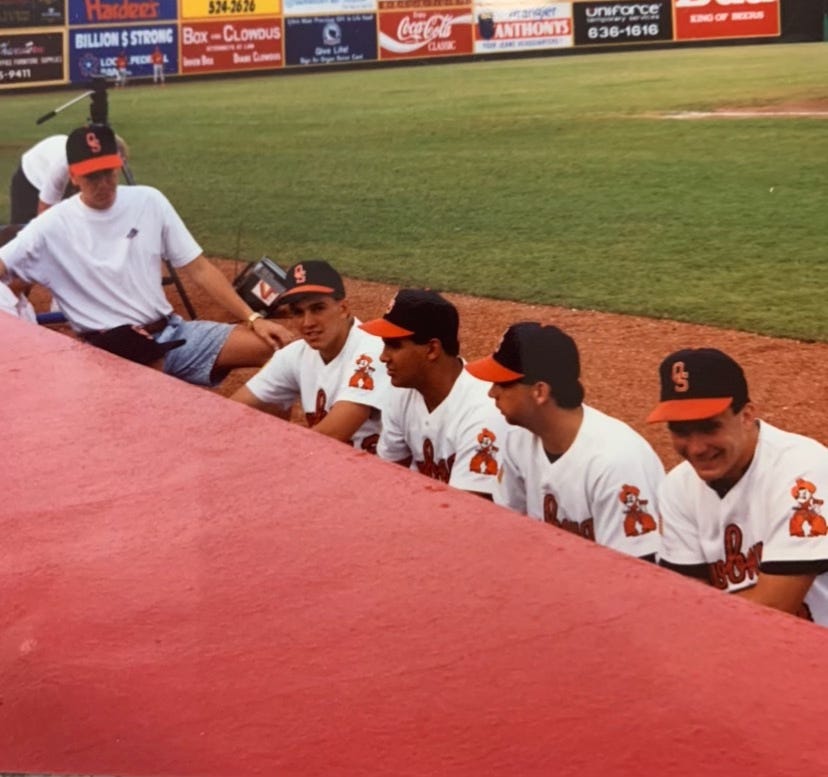
JC: Yes, I was asked which sport I wanted, and I chose baseball. In 1985, Pete Incaviglia set NCAA records for home runs (48) and RBIs (143), and then in 1987, Robin Ventura had the 58-game hitting streak. So I am in my early 20’s, and I am having conversations with USA Today, Sports Illustrated, and The New York Times. I have two of the hottest commodities in baseball and probably still two of the greatest offensive seasons in college baseball history.
AJS: What was Incaviglia like?
JC: He was this big, brash guy, but he was one of the first guys who made me feel like I was part of the team. Now, I am the guy keeping stats. He was a great teammate, and just like with Robin, he was having all this happen (with the records), but it was always about the team winning.
Pete was always about other people. One time, I was playing golf with my dad and two of his friends, and we heard someone yelling, ‘Fix, Fix’. Next thing we know, this really big guy, no shirt on, flimsy track shorts, and golf spikes on, with a golf club in his hand, is running towards us, yelling. So my dad and his friends get behind the golf cart.
It is Pete, and he says, ‘Do you have any chewing tobacco?’ So we give him some chewing tobacco, and he just says ‘thanks’ and runs off the way he came. My dad’s friend says, ‘Was that Pete Incaviglia? And I said, ‘Yes’. And he says, ‘Oh, seems like a nice guy.’
Pete was a great guy, but when all you see is this huge guy running towards you with a golf club, you think you are going to die.
AJS: What about Robin?
JC: “Well, in my Substack, I tell the story about Robin’s hitting streak. And in the game where he was in his last at bat and his streak was in the 30s, and he had not gotten a hit, and it was a 3-2 count, I truly believe that if the pitch had been outside the zone, he would not have swung at it”.
AJS: That was also around the time when Thurman Thomas and Barry Sanders were at Oklahoma State as running backs, right? Did you know those guys?
JC: Yes, Thurman was there in 1986 when I was working in sports information. By the time Barry was setting records in 1988, I was not in sports information there. But I remember running into him one time in the parking lot, and I asked him how it was going with all the media attention. And he said, ‘It’s a bunch. And I said, ‘Yeah, I went through it with Robin, and it is a lot of people coming at you.’
And I will never forget he looked at me and said, ‘Well, I have nobody to blame but myself’. And I said, ‘What?’ And he says, ‘Well, it’s because of what I am doing that they all want to talk to me’.
AJS: I am a big country music fan, so I have to ask, did you know Garth Brooks?
JC: I did not know him, but my friend Brett McMurphy (a prominent college football reporter formerly with ESPN and The Tampa Tribune) went to the same high school with Garth and ran track and played football with him.
While in Stillwater, Garth worked at Dupree Sports. It was across the street from Wild Willie’s, where he would play open mic nights. When I was with OSU baseball, Coach Ward came up with the idea of having a concert with Garth Brooks to raise money for the program. I was with OSU baseball until ‘94, so Garth was getting big, really starting to kind of explode. So Coach Ward calls over to Eddie Watkins, who runs Duprees, and asks him to check with Garth to see if he would do this concert.
When Eddie calls him back, he says he talked to Garth, and Garth says, ‘Coach Ward wants to talk with me? He’s a big deal. (Oklahoma State had gone to seven straight College World Series).
So for two weeks, I had to listen to Coach Ward every time he walked through my office, say, ‘Garth Brooks thinks I am a big deal.’ Next thing you know, the athletic department as a whole takes over the concert, and we had two sold-out shows, but none of the money went to baseball.
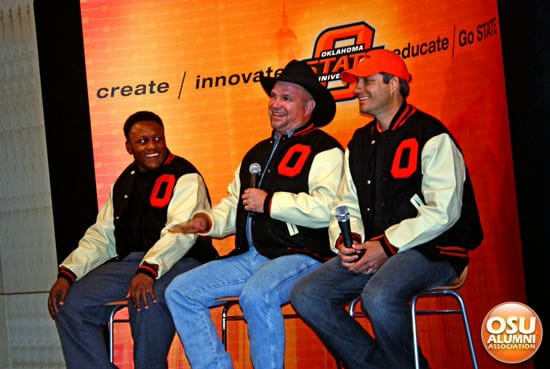
In 2009, Garth was elected into the OSU Alumni Hall of Fame along with Barry Sanders and Robin Ventura. They served as the Grand Marshals for the Homecoming Parade, and Garth kept saying to people, ‘Take lots of pictures, y’all, I want people to know I know these two guys. And he was way more famous than they were at that point, but to him, they were a big deal because they had played in the NFL and MLB.
Typically, at OSU football games, Brooks’ signature song Friends in Low Places is played at the end of the third quarter. On this night, it was played at halftime along with Take Me Out to the Ballgame for Ventura.
AJS: You mentioned being with Oklahoma State until 1994. Where did you go then?
JC: I went to Sioux City, Iowa, to work for the Sioux City Explorers, a team in the independent Northern League in baseball. We got to Sioux City in February and left by September because the company that owned that team also owned the Boise Hawks. So they moved to Boise, and I still did everything for the Explorers - the press releases, the baseball cards, the program features - and then I started doing the same for the Hawks, and then we bought the El Paso Diablos, and so I would come in the morning and do game notes and all these things, just working my way across the country and ending with Boise.
AJS: How was doing minor league baseball different from OSU?
JC: Well, at OSU and in college athletics, you don’t have to promote it as much because you have a built-in fan base of alumni. With minor league sports, when I first got there, I did not understand why we were going to have ‘Agg Night’ or the different promotions, because I had come from Oklahoma State, where we had a very successful baseball team. People bought tickets.
But then you get to the minor leagues, and you have to come up with ways to get people there. I am not going to lie. When I started, I was a purist. It’s a baseball game. We don’t need anything else. But as I watched, learned, and grew more mature, I understood that you do have to come up with ways to get people to attend games.
One of the things I learned in Idaho is if you can take a player and they are no longer a number. You mentioned you like writing about the human-interest side of sports. And those are the important stories. And we learned particularly later, when we added a hockey team, the Idaho Steelheads, that if you can take a player and get them out into the schools, the libraries, and into the community, that’s no longer number 22, that’s Cal Ingraham, and he came to my school.
AJS: What is your best minor league promotion story?
JC: My first year in Sioux City was when David Letterman would give his Top 10 list and say from our home office in Sioux City, Iowa. So we had a Letterman night promotion. And so we brought in Mujibir, one of the two shopkeepers on the Letterman show, and Larry Bud Melman. (Mujibir was a Bangladeshi shopkeeper in the building where Letterman filmed).
So, Sioux City, because it is an independent league, signed Mujibir, the shopkeeper, as a pitcher. And the whole plan is well thought out. Mujibir will be the starting pitcher. He will throw one pitch, then grab his elbow. We will have the trainer come out, and an injury replacement come in, who is our real starter.
And all of a sudden, now Mujibir shows up, and he is in a three-piece suit. So we had to take him to the locker room. And the players were not crazy about this whole thing; they often didn’t like the promotions. So now we have to get Mujibir dressed in a baseball uniform, and he needs shoes, but the players are basically icing him out. Finally, one of the pitchers comes up and drops a pair of spikes by my feet, and I let Mujibir borrow my glove.
Now, he has never thrown a baseball before. So he goes down to the bullpen, and the pitching coach and a couple of guys are teaching him how to throw. And then he starts playing catch with our second baseman, Lance Robbins, so now we have him close enough that we have to sink or swim.
So the team runs out to take the field, and Mujibir runs to second base with Lance because that’s his buddy, instead of to the pitcher’s mound. Finally, Lance gets him to the mound. Now he has the ball, and he throws it... But not to the catcher; he throws it to Lance at second base.
We were playing St. Paul. The St. Paul hitter steps to the plate, and our biggest fear was not to throw it anywhere near the zone because we are afraid this guy is going to hit a line drive off his head.
So he throws the pitch and immediately grabs his left arm, which is his glove arm, instead of the right arm he is supposed to grab. And the trainer is slow on the draw to go out and declare him unfit to pitch because he is rolling on the ground laughing.
AJS: What about for minor league hockey?
JC: Screensaver giveaway. The Internet was still in its infancy, and people were given 3.5-inch floppy disks with an Idaho Steelehads screensaver that included a schedule. Well, sometime during the game, someone thought, gee, I wonder how well a 3.5-inch floppy disk flies. And so they threw it onto the ice, and there is a little metal spring in there that controls that door, and that spring is a piece of metal. A piece of metal in the ice does not work well with a hockey skate; it will cause an abrupt stop. So now we had to stop the game to find that damn piece of metal on the ice.
We learned that the big difference between hockey fans and baseball fans is that hockey fans will throw anything you give them. Megaphone giveaway night, that’s on the ice.
AJS: What was your job at The Professional Bull Riders (PBR)?
JC: My job pretty much was to go into a town and introduce bull riding. So we would go to a city with an event on Friday and Saturday night, and one of the cowboys, and I would get up at 5 AM to do the local morning TV stations, or we would go to a Bass Pro Shop or do a signing at a bar for a Jack Daniels event.
Typically, when you market minor league sports or other events like the PBR, you target moms because they plan the family’s calendar. The riders used to crack up at this and say, "So you are telling me we are trying to convince moms to bring out their little kids to watch us get thrown off 2,000-pound bulls and possibly get stepped on.” And I said, yes, exactly.
Those guys were amazing. It is one of the purest sports. They are not a sideshow or a carnival act. They are serious athletes.
One time, Chad Ochocinco, the Bengals receiver, decided he wanted to try riding a bull. Ochocinco tweets I want to ride a bull. So next thing you know, we are all in Georgia, and Ochocinco got a bull riding 101 class from Ty Murray and Cody Lambert. The first thing they teach him is how to fall off and run to the fence so you don’t die.
AJS: Wow, I am having a hard time imagining Ochocinco on a bull.
JC: The thing is, anybody who knew Ochocinco, that dude was brash. And then I was introduced to him like Jack, this is Ochocinco. And he says in this very soft voice, ‘Please, call me Chad.’ He was the calmest, nicest, politest person.
AJS: When I was looking you up, I saw you work now for the Wrestling Hall of Fame. I assumed it was WWE, but it looks more like collegiate and Olympic wrestling.
JC: Yes, everything at the Wrestling Hall of Fame in Stillwater is real wrestling. We are planning our 50th anniversary celebration and will mark it through June 27th. The way I explain it to everyone is that the Wrestling Hall of Fame is the same as the Baseball Hall of Fame in Cooperstown, or the Basketball Hall of Fame in Springfield, MA, or the Football Hall of Fame in Canton, Ohio. It is a museum, and there are also Distinguished Members, like Hall of Famers, who get a bust in Canton or a bronze plaque in Cooperstown. The wrestlers actually get a granite plaque made out of red Oklahoma granite.
AJS: Have you been to Cooperstown?
JC: I have been to Cooperstown. It was really cool because I got to see Robin’s bat from the game where he hit two grand slams. And it was cool because I have the bat he used during the 58-game hitting streak. And everybody is like, ‘How did you get it?’ I said, ‘I asked him for it.’ It is now kind of a running joke where Robin says to me, ‘I always had to keep up with where you were because whenever somebody wanted to buy the bat, I had to tell them where they could find you.
AJS: I could see where that might be a challenge with all you have moved around from Stillwater to Sioux City to Boise to New Jersey to Pueblo, CO, and then back to Stillwater.
JC: He told me one time someone said they would give him ten thousand dollars. The thing I found out, though, is that if you keep a bat like that in storage and then take it out for a picture for your Substack, pine tar flakes fall all over the floor, and your wife makes you vacuum them up.
AJS: Speaking of your wife, she must be a saint to have moved so many times for your job.
JC: My wife, Rashel, is from a small town in Oklahoma and always wanted to travel, so she always saw it as an adventure.
AJS: What do you think has helped you be successful in sports?
JC: Coach Ward is 85 now and still lives in Stillwater, so we are friends and go out to lunch when we can, and we cover all kinds of topics. And one day, he says to me, the first time I saw you, the word I thought of was defiant, the way you are and the way you carry yourself, is don’t tell me I can’t do something because I will show you I can do it.
When you work in athletics and with athletes, it is very black-and-white. Somebody wins, and somebody loses. And they are very driven, but it doesn’t always work out the way you would want.
My mother, when I went to college, wanted me to join a fraternity. I did not want to join a fraternity; it probably isn’t the place for someone who is defiant. And later in life, she said to me, ‘Well, you didn’t join a fraternity, but you kind of formed your own with all the people you worked with.’
I was lucky not only to work with athletes but also with the people around them - the equipment managers and trainers, the coaches at Oklahoma State, the front-office people in minor league baseball, and managers. It was a lot of fun. They are all still my friends.
AJS: Jack, it has been a pleasure to talk with you. Congratulations on a great career, and best of luck with your Substack.
Thank you to Adam Steinmetz for the interview and for writing such a generous piece.
I’ve spent my entire career trying to get attention and publicity for other people, so turning the spotlight around on myself is a bit outside my comfort zone.
Adam tells stories worth reading, which I can say with great confidence are far more interesting than me.
I highly recommend exploring his other work.